Basketball is played by two teams trying to score in the opponent’s basket while defending their own. Five players from each team are on the court at a time, with substitutions available during stoppages.
The basic objective is simple, but competitions can differ in quarter length, foul limits, timeouts, and certain violations. This guide explains the shared foundations and highlights where NBA and international rules may differ.
Table of Contents
ToggleHow possession works
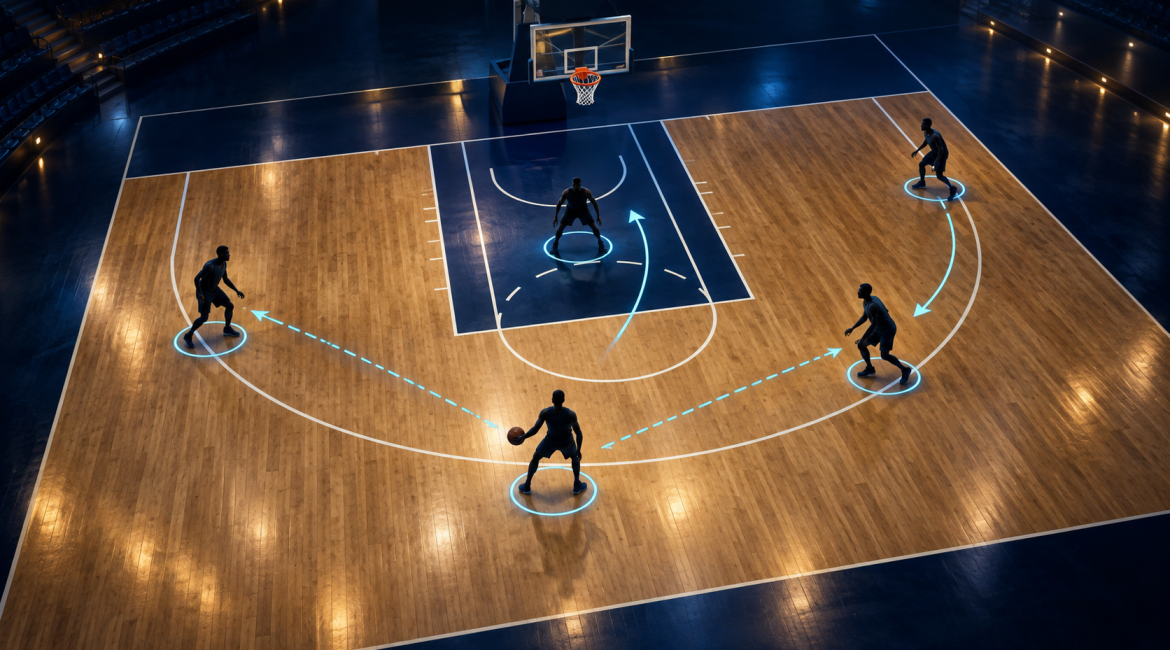
A game normally begins with a jump ball. The team in possession moves the ball through passing and dribbling while trying to create a shot before the shot clock expires.
A player who stops dribbling may pass or shoot but cannot normally begin dribbling again. Moving illegally while holding the ball is travelling, while stopping and restarting a dribble is a double-dribble violation.
A possession may end through:
- A successful basket
- A missed shot recovered by the defence
- A turnover
- A violation
- A foul that leads to free throws or a new possession
- The shot clock expiring
Rebounds are therefore important. A defensive rebound usually ends the opponent’s possession, while an offensive rebound gives the attacking team another opportunity.
Basketball scoring
The location and type of shot determine its value:
- Three points: a successful shot taken from beyond the three-point line
- Two points: a successful field goal taken from inside the three-point line
- One point: a successful free throw
The three-point line is not identical in every competition, so shooting distances differ between NBA and international basketball.
Free throws are awarded after certain fouls. The number of attempts depends on the type of foul, whether the player was shooting, and the competition’s team-foul rules.
Game time and the shot clock
Basketball games are divided into four quarters. NBA quarters last 12 minutes, producing 48 minutes of regulation time, while FIBA games use 10-minute quarters for 40 minutes of regulation time.
If the score is level when regulation ends, overtime periods are played until a winner is determined.
The attacking team generally has 24 seconds to attempt a shot that touches the rim. It must also move the ball into the frontcourt within the permitted time. These limits prevent teams from holding possession indefinitely.
The game clock stops for specified events, including fouls, timeouts, and certain out-of-bounds situations. As a result, the final minutes of a close match can take considerably longer than the time displayed on the clock.
The five traditional positions
Modern players often perform more than one role, but the five traditional positions remain useful for understanding team structure.
Point guard
The point guard commonly brings the ball into attack, organises possessions, and creates opportunities for teammates. Ball control, passing, and decision-making are central to the role.
Shooting guard
A shooting guard is often expected to score from the perimeter, move without the ball, and support the primary ball-handler. The position may also defend opposing guards.
Small forward
The small forward usually combines perimeter and interior responsibilities. Players in this role may shoot, drive towards the basket, rebound, and defend several positions.
Power forward
Power forwards traditionally operate closer to the basket, contributing through rebounding, screens, interior defence, and short- or mid-range scoring. Many modern power forwards also shoot from long range.
Centre
The centre generally plays near the basket and contributes through rebounding, rim protection, screens, and close-range scoring. Height is useful, but positioning and timing are equally important.
Fouls and violations
A foul normally involves illegal contact or unsporting conduct. Common examples include holding, pushing, blocking illegally, or making prohibited contact with a shooter.
The consequence may be possession from the sideline or one or more free throws. Players and teams are also subject to foul limits, although the exact thresholds differ between competitions.
Violations usually involve ball handling, movement, positioning, or timing rather than illegal contact. Common violations include:
- Travelling
- Double dribble
- Carrying the ball
- Stepping out of bounds
- Returning the ball illegally to the backcourt
- Failing to attempt a shot before the shot clock expires
- Remaining in a restricted area longer than permitted
Some details, including three-second rules and defensive restrictions, differ between NBA and FIBA basketball. Competition-specific rules should therefore be checked when a precise ruling matters.
NBA and international basketball
The foundations remain similar across major competitions, but court dimensions, three-point distance, game length, timeouts, foul limits, and defensive rules may differ.
The NBA format guide explains how the American league organises its teams, regular season, Play-In Tournament, and playoffs.
Basketball knowledge is also useful when interpreting sports markets. The basketball betting guide explains how match rules connect with spreads, totals, overtime settlement, and player markets without suggesting that knowledge guarantees a result.
The Game at a Glance
Basketball is built around possession, movement, timed attacks, and tiered scoring. A basic understanding requires knowing how two- and three-point shots work, what the shot clock does, how the five positions differ, and why fouls are treated separately from violations.
Once those elements are familiar, it becomes easier to follow tactical changes, substitutions, late-game decisions, and differences between competitions.